

Why Rotate the Tires?
The front tires on most vehicles tend to wear out faster than the rear tires. This is due to the effects of steering the vehicle and the weight transfer that occurs during braking. To ensure that all four tires wear evenly, it is important to rotate them on a regular basis. Tire rotation helps maintain balanced handling because it allows all four tires to wear at the same rate. Keep in mind, as tire wear reduces tread depth, it increases the tires’ response to driver inputs. Consequently, by equalizing tire wear at all four corners, dry road performance is actually enhanced.
Another advantage of regular rotation is that it allows the tires to be replaced in complete sets rather than in pairs. This maintains handling continuity. It also enables drivers to take advantage of the latest in tire technology, instead of trying to match a pair of older tires.
How often should they be rotated?
Most manufacturers list rotation intervals in the scheduled maintenance section of the vehicle service manual and/or the owner’s manual. Tire rotation patterns can also be found there. If this information is unavailable for a particular vehicle, rotate the tires every 6 months or 5,000 miles following the appropriate rotation sequence shown in the illustrations. After completing a tire rotation, be sure to reset inflation pressures to the manufacturer’s recommended specifications indicated on the vehicle tire placard.
It may also be necessary to reset the Tire Pressure Monitoring System on some newer vehicles.
Tire rotation will not correct irregular wear, wheel alignment or worn suspension components. If these conditions exist, an inspection should be performed to identify the repairs necessary to correct the problem.
Vehicle Tire Placard
Since 1968, cars and light trucks sold in the United States have been required to have a tire information sticker, called a vehicle tire placard.
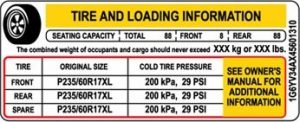
The vehicle tire placard indicates the size of the original equipment tires (including the spare), cold inflation pressure for the tires on both axles as well as the spare, and load index or range. Depending on the vehicle, the vehicle tire placard will either be located on the edge of any door, the doorpost, glove box, fuel door or inside trunk lid.
If the tire placard is missing, consult the owner’s manual, vehicle manufacturer, or tire manufacturer regarding applicable tire information. Always refer to the vehicle manufacturer’s recommendations before replacing tires.
Tires should always be replaced with the same size designation, or approved options, as recommended. Never choose a smaller size with less load carrying capacity than the size on the tire placard.
NOTE: It is not always possible to select a replacement tire with exactly the same size as shown on the placard. Consult with a vehicle or tire manufacturer for replacement recommendations.
(Some vehicle manufacturers require different-sized tires for either the front or rear axles.)
Things to watch for
- Do not mix size or type (all season, performance, mud and snow) of tires on the same axle
- When replacing only two tires on front or rear drive vehicles, it is preferable to place the two new tires on the rear
- If radial tires and non-radial tires are mixed on the same vehicle, the radials must be on the rear
- Mount tires only on same or approved rim widths
- Proper wheel alignment adjusts the angle of the wheels so they are positioned correctly relative to the vehicle’s frame and maximizes the life of your tires



I’m thankful that your article mentions the importance of rotating tires both every 6 months or every 5,000 miles to ensure that your vehicle works as well as possible. My son recently told me that his car seemed to not turn as well as it used to back when it was new. I’ll look into tire services to try and determine what the cause could be.
thanks for the information
good one keep it up
Oh, I’d heard of tire rotation for years, but I’d never known what it is. So, thank you for explaining that you actually switch the tires on your car. In any case, I think my tires might be in need of an alignment.
Thank you for your tip to not mix the size or type of tires that are on the same axle. My car has been acting a little funny and pulling to the right. I think it may be time for me to get my alignment checked.
I find it helpful to know that it’s recommended to replace the two tires at the rear of the car if replacing only two tires. My husband wants to buy new tires for his car, but we can only afford to buy two as of now. I’ll share this advice with him and accompany him tomorrow to a reputable tire shop in town. Thanks.
Thanks for explaining that tires should be rotated every 5,000 miles. I know my son has been driving his car for over a year, but I don’t think he’s ever rotated his tires. I’ll call him this week and see if his are worn down and need to be replaced at all.
I’m glad I came across your article and read about tips on maintaining and servicing my car.
My dad recently bought me a car, and I’m looking for ways that I can provide extra care to it.
I like how you pointed out the importance of rotating the tires 5,000 miles.
very clear and good article easy to understand. Thank you